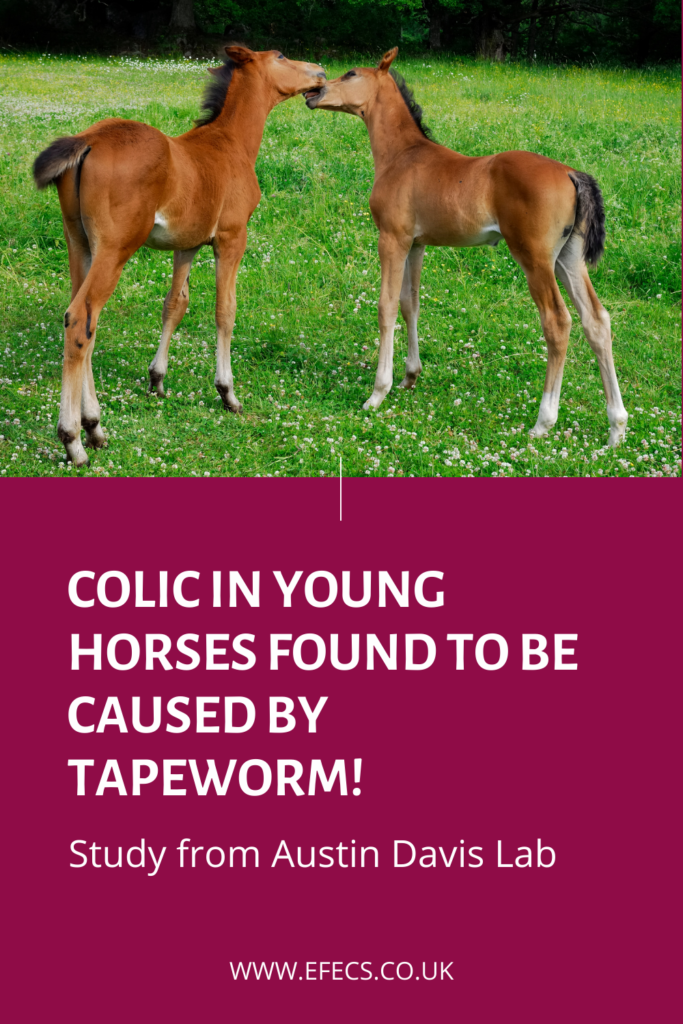
A study released by the Lab at Austin Davis Biologics Ltd – the founders of the EquiSal tapeworm saliva test, showed that Tapeworm infections were found to be a significant concern in colic cases of four yearlings.
“Tapeworm should be considered a significant pathogen in young horses“. they said
Colic indicates pain in the horse’s abdomen. Often deemed unpreventable and unpredictable it’s a huge concern to every horse owner!
The Study
The individual colic cases occurred over several years (one in 2014, and three in 2019/2020) at a well-managed Thoroughbred stud farm.
Sadly two of the yearlings required euthanasia while two made a full recovery!
Post-mortem examinations of three yearlings revealed large live tapeworm infections, and three of the cases suffered ileocaecal intussusception; which is where a section of the intestine slides inside an adjacent section.
The most concerning finding was that the yearlings had been treated with praziquantel (tapeworm treatment) at 6 and 12 months of age! And that two of the live tapeworm infections were discovered just days after the yearlings had received the praziquantel dose, raising suspicions of praziquantel resistance (meaning the drug may no longer be effective in killing tapeworms).
During 2019, all 15 yearlings on the stud farm were tested using the EquiSal Tapeworm saliva test and were all found to have high ‘saliva score’ results, therefore demonstrating significant tapeworm-specific antibody responses.
Repeat testing over 14 weeks after treatment showed seven yearlings with reductions in specific antibody levels, but five yearlings remained the same or increased.
The only yearling to reach ‘low’ diagnosis after treatment was a filly who had previously spent time on box rest without access to grazing.
It is expected that significant reductions in EquiSal saliva scores will occur within two to three months of treatment providing there is no reinfection or evidence of resistance.
Research
Research conducted by the EquiSal team has shown that in horses where tapeworm reinfection is prevented (by restricting access to grazing), 90 % of horses in the study (19) reduced to low within 10 weeks and all had reduced to low within 12 weeks.
Jess Spanton, the lead veterinary surgeon, commented,
“While this case study hasn’t generated firm conclusions of praziquantel resistance, the large live tapeworm infections discovered days after treatment are very concerning, suggesting that a level of resistance to anti-tapeworm treatments is a strong possibility.
Tapeworm infections in horses, and in particular youngstock, should be closely monitored to prevent horses suffering clinical disease, which in some cases can be severe.
The benefit of testing for tapeworm is that anti-tapeworm dosing frequency and management practices can be altered in response to results, and in some cases may identify whether there is a potential for resistance.’
Dr Corrine Austin, founder of EquiSal Tapeworm testing, said,
“It is very common for horses in high-risk environments, such as youngstock or herds with existing tapeworm infections, to have high EquiSal results despite receiving 6 monthly doses of anti-tapeworm treatment.
Our research has shown that this is usually due to rapid reinfection from the pasture after treatment.
More frequent saliva test monitoring and subsequent treatment is essential to manage horses at risk of developing clinical symptoms.
Just as important is identifying horses which don’t need treatment – approximately 70% of those tested – meaning the only two drugs we have available for treating tapeworm can be saved for when they are really needed, thus slowing the development of resistance.””
CONCLUSION
This study reaffirms the need for regular tapeworm testing and not relying on treatment alone to protect your horse from tapeworm.
If you can, put your horse on box rest and restrict their grazing after they have been treated. This should help significantly to prevent the risk of rapid reinfection.
You can read the full press release and see the poster presented at the Equine Colic Symposium here.
For more information on Tapeworm in Horses see the Info Hub